
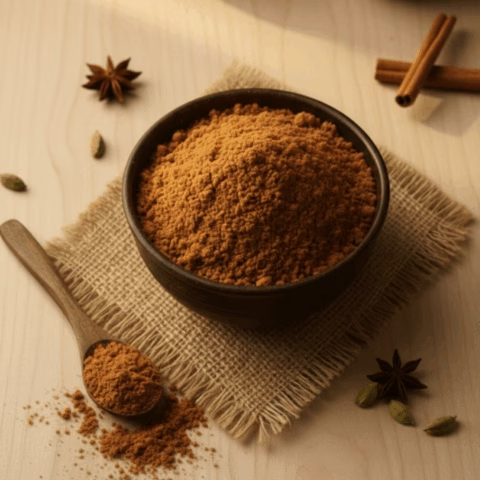
What Is Palm Jaggery?
Learn Once Benefit for Life
Unlike industrial sweeteners, palm jaggery is created through slow, open-pan boiling of palm sap, preserving its natural character and flavour.
Watch
Read


How to Use & Cook
Palm jaggery can be grated, powdered, or melted into syrup. For syrup, dissolve jaggery in water, strain, and use as required in recipes.
Usage
Use as a regular culinary sweetener in moderation
Cooking Videos
Important Usage Notes
About this Product
Palm jaggery has long been a part of Indian kitchens, valued not for perfection or uniformity, but for its authenticity. At Roodi Food, we source palm jaggery made in small batches, staying close to traditional preparation methods.
The result is a pure, unblended sweetener that retains its natural identity—free from industrial shortcuts and unnecessary processing.
Traditional Context
Palm jaggery has been traditionally prepared in many parts of India as a seasonal sweetener, often linked to local harvest cycles and festive cooking.
Nutritional Nature
Palm jaggery contains naturally occurring sugars and trace minerals that originate from palm sap during traditional preparation.
FAQs
Please note that the views and information presented on external websites are those of the respective authors and do not necessarily reflect the views of Roodi Food.
Detailed Description
Palm Jaggery, also known as Karupatti or Taal Gur, is a traditional natural sweetener prepared by slowly boiling fresh palm sap until it thickens and solidifies into jaggery blocks. This method has been practiced across India for generations as a way of preserving the natural sweetness of palm sap without refining.
Compared to refined sugar, palm jaggery is valued in traditional food systems for its depth of flavour, natural colour, and minimally processed nature.
At Roodi Food, our Palm Jaggery is prepared using time-honoured methods, without chemical processing or additives, to retain its original character and purity.
Why Choose Roodi Food’s UNCOMPROMISED Palm Jaggery?
How uncompromised?
-
Naturally Sourced – Obtained from palm tree sap using traditional tapping practices
-
Traditional Preparation – Slowly prepared in small batches using open boiling
-
No Refining – Free from bleaching agents, white sugar, or artificial additives
-
Pure & Unblended – 100% palm jaggery, not mixed with sugar or jaggery powder
-
Mineral Presence – Naturally contains trace minerals present in palm sap
-
Clean & Honest – No preservatives, colours, or adulterants
The sweetness of nature — simple, traditional, and uncompromised.
🌴 1. Sourcing & Varieties
Palm jaggery is derived from the sap of trees belonging to the Palmaceae family.
During the flowering season, the sap is collected by making a careful incision on the palm inflorescence and allowing the natural sap to drip into clay or food-grade containers.
The collected sap is gently boiled, thickened, poured into moulds, and cooled to form jaggery blocks.
Common palm sources include:
-
Palmyra Palm
-
Date Palm
-
Fishtail Palm
-
Coconut Palm
Different palm varieties produce jaggery with distinct colour, aroma, and flavour profiles.
🍯 2. Composition & Nature
Palm jaggery is a naturally occurring carbohydrate source derived from plant sap.
Unlike refined sugar, it undergoes no crystallisation or chemical separation, allowing the original components of the sap to remain largely intact.
Its sweetness profile is softer and more rounded, with a deep caramel-like flavour that differs from sugarcane jaggery and refined sugar.
🌱 3. Traditional Food Context
In traditional Indian food practices, palm jaggery has been used as:
-
A natural household sweetener
-
A base ingredient in laddus, chikkis, payasams, and festive foods
-
A flavouring agent in herbal decoctions and traditional beverages
These uses are part of long-standing culinary traditions and cultural food wisdom.
Palm jaggery is a food ingredient, not a medicinal product.
🌏 4. Environmental & Socio-Economic Context
-
Low-Input Cultivation – Palm trees grow naturally with minimal external inputs
-
Cottage-Scale Production – Typically prepared in rural, small-scale setups
-
Traditional Livelihoods – Supports palm climbers, local processors, and village economies
-
Naturally Resilient Trees – Palms are long-living and well adapted to local climates
Choosing palm jaggery helps sustain traditional food systems and local craftsmanship.
⚖️ 5. Palm Jaggery vs Refined Sugar (Food Perspective)
-
Processing Level – Palm jaggery is minimally processed; refined sugar undergoes extensive industrial refining
-
Flavour Profile – Palm jaggery has a deep, earthy sweetness; sugar has a sharp, neutral sweetness
-
Culinary Use – Preferred in traditional recipes where flavour depth is valued
This comparison is based on processing and culinary characteristics, not medical outcomes.
🍽️ 6. Usage & Culinary Applications
As a Sweetener
Used in place of refined sugar in traditional and home cooking.
In Beverages
-
Herbal decoctions
-
Millet-based or plant-based drinks
-
Traditional porridges
In Recipes
-
Millet sweets and desserts
-
Traditional festive preparations
-
Laddus, chikkis, halwas, and burfis
-
Home-style baked or cooked dishes
Cooking Tip
To prepare syrup, melt jaggery with water, strain if needed, and use as required.
🍬 Recognising Authentic Palm Jaggery
-
Colour: Dark brown to deep black
-
Aroma: Earthy, smoky, caramel-like
-
Texture: Dense blocks or grated form; may be slightly sticky
-
Taste: Milder and more complex than refined sugar
Natural variation in colour and texture is expected.
📌 Important Instructions
-
Store in an airtight container
-
Keep away from moisture and humidity
-
Product may soften or liquefy naturally in warm or humid conditions
-
Grate or melt before use for convenience
💡 Did You Know?
-
Palm jaggery has been part of Indian culinary traditions for centuries
-
Its production relies on seasonal sap collection and skilled craftsmanship
-
Each batch reflects natural variations in climate and palm variety
❓ Frequently Asked Questions
Q1: Is palm jaggery a natural product?
Yes. It is made directly from palm sap using traditional boiling methods without refining.
Q2: Does palm jaggery contain additives or preservatives?
No. Roodi Food’s palm jaggery contains only palm sap.
Q3: Can it be used daily in cooking?
It is traditionally used as a regular household sweetener. Consumption should always be balanced as part of an overall diet.
Q4: Why does the texture change over time?
Palm jaggery is naturally hygroscopic and may soften due to humidity. This is normal.


