
A Dog Chasing Vehicles. A Human Chasing Money.
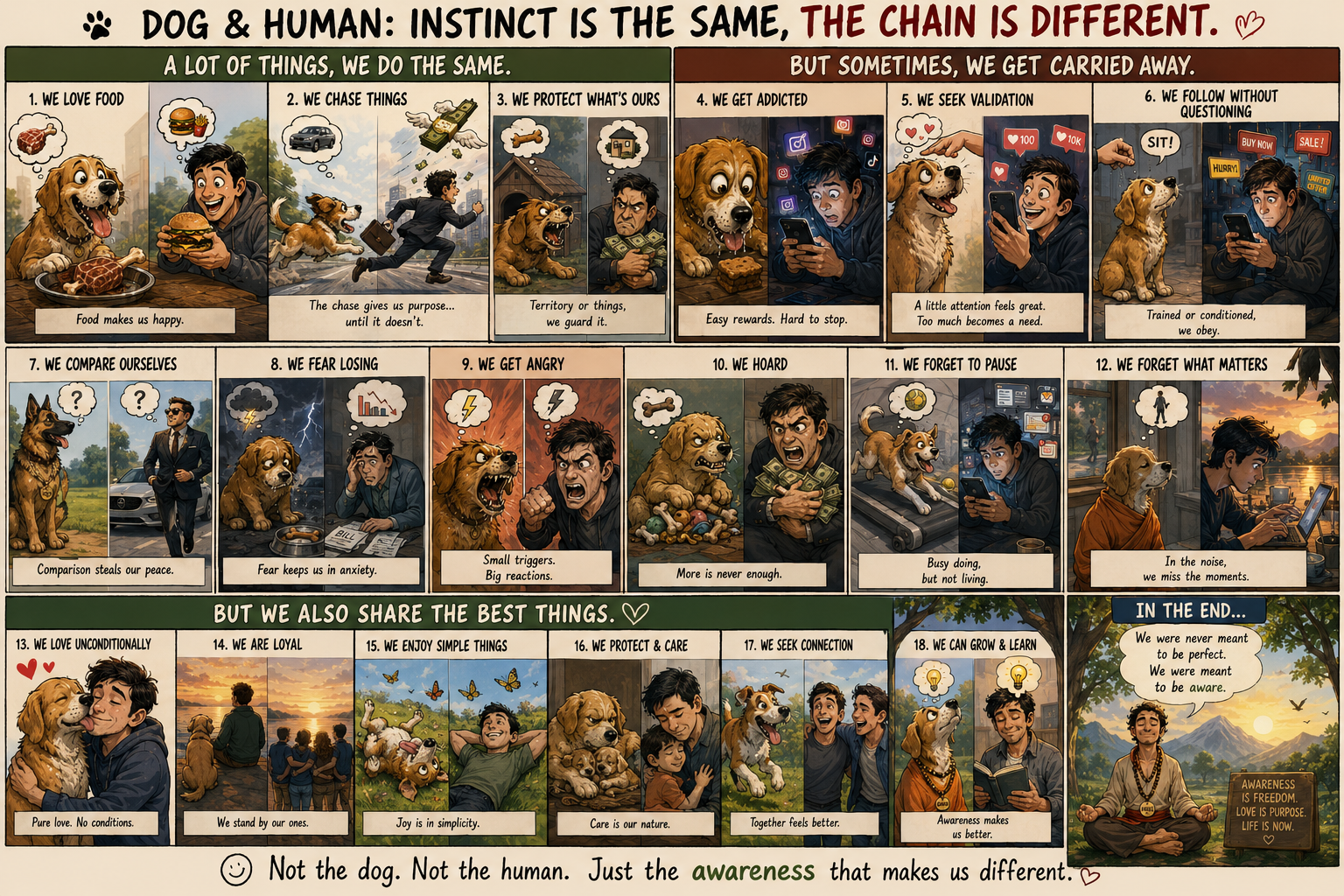
What if we’re not as different as we think?

There is a dog in every neighborhood that loses its mind when a car goes by. It sprints alongside the vehicle, barking with full conviction, muscles firing, eyes locked. And then — if you watch long enough — something quietly absurd happens: the car stops at a light. The dog slows. It sniffs the tire. It walks away.
It had no plan for catching it.
Watch a human chase money for a few decades and you’ll notice an unsettling echo. The sprint, the focus, the full-body commitment. The arrival — the number reached, the milestone cleared — followed by a strange flatness. Then a slightly larger target appears on the horizon.
The nervous system, it turns out, is optimized for the chase, not the having.
The Loop Your Brain Is Running
Neuroscience has a name for this: the dopamine anticipation loop. Contrary to popular belief, dopamine is not the pleasure chemical — it’s the wanting chemical. It floods the system in anticipation of reward, not in response to it. This is why the pursuit often feels more alive than the arrival.
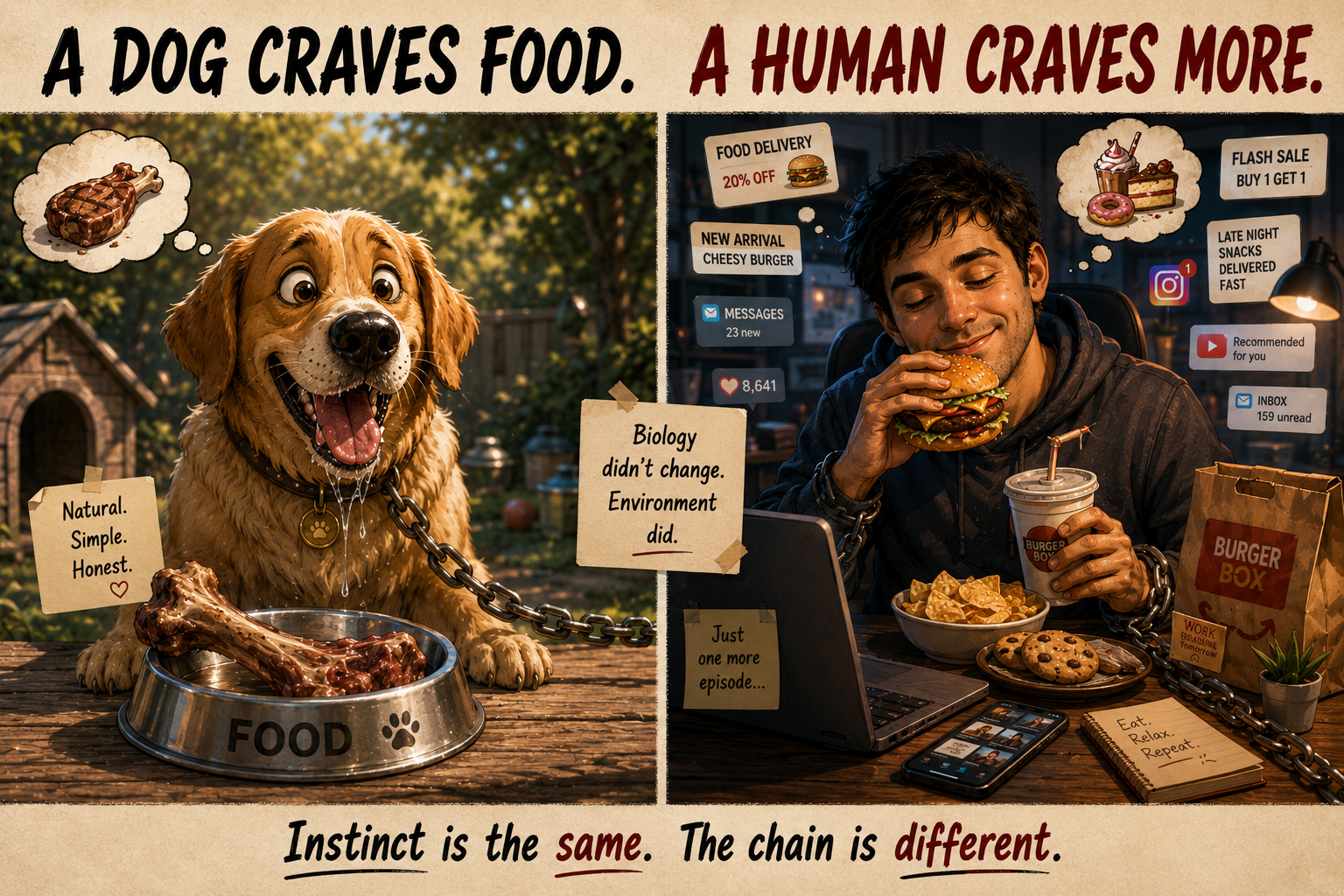
Both the dog and the person chasing money are caught in this loop. The dog sees movement; ancient prey-drive circuits fire; the chase becomes its own reward. The human sees financial opportunity; survival and status circuits activate; the accumulation feels urgent in a way that is difficult to reason with.
Neuroscientists call it motivational salience — the brain tagging certain stimuli as must pursue. The problem is that the system was calibrated for a world of real scarcity. When modern finance hijacks circuits designed for finding food, the “enough” signal never quite arrives.
Psychologists have a term for the moving goalpost: the hedonic treadmill. Pleasure from any gain decays rapidly toward baseline, which is why the person who thought ₹1 crore would bring peace finds themselves, with ₹5 crore, chasing ₹10.
“Money is not merely paper psychologically.” The brain often interprets it as future food, safety, reduced uncertainty, and something subtler — proof that you are not disposable to the tribe.
That last one deserves a pause. In the ancestral environment, falling to the bottom of the social hierarchy meant worse food, less protection, reduced access to mates. Status anxiety wasn’t vanity — it was survival. Modern wealth accumulation hijacks this ancient terror. We aren’t just chasing stuff. We are chasing the feeling of not being expendable.
The Absurdity Hiding in Plain Sight
A dog has no use for a Honda Civic. It could not sit in one, drive one, or sell one. Its entire nervous system is reacting to the movement of a machine it fundamentally does not understand.
A human who has spent thirty years optimizing for income often, upon honest reflection, has no clear answer for what they would do with an extra ₹10 crore beyond buying a slightly larger version of what they already have. The vehicle changes; the chase doesn’t.
This is not a cynical observation. It is simply what happens when ancient instinct meets modern symbols. The dog’s prey drive was hijacked by the internal combustion engine. The human’s survival drive was hijacked by financial abstraction.
Buddhism noticed this long before neuroscience. The Pali word tanha — often translated as craving — describes not just wanting things but the compulsive, self-perpetuating quality of the wanting. The problem isn’t desire itself. It’s the loop that keeps resetting, the goalpost that keeps moving, the mind that always negotiates: after this, I’ll rest.
Hindu and Yogic thought draws a sharper line — not between wealth and poverty, but between wealth as tool and wealth as identity. The first is dharmic; the second colonizes the self. The question is not what you have but what has you.
The Stoics arrived at similar territory from a different direction: if your peace of mind depends on market performance, income growth, or status signals, you have handed the controls of your inner life to something that does not care about you.
The Human Edge: Where the Analogy Ends
The comparison has real limits, and they matter.
A dog cannot step outside the loop and ask why it is running. A human can. That gap — the capacity for self-reflection — is not a small thing. It is the difference between a mechanism and a person.
Money, unlike the Honda Civic, is also genuinely useful. It is one of civilization’s most powerful coordination technologies — enabling specialization, trade, infrastructure, science, art, medicine. The danger is not money. It is the moment money shifts from tool to terminal goal, from instrument to identity.
Humans have built hospitals, preserved seeds, funded revolutions, and fed strangers with money consciously directed. None of that is available to the dog.
The question is not whether to pursue — it is who is doing the pursuing. Conscious ambition and compulsive chasing can look identical from the outside. They feel very different from the inside.
What You Are Actually Chasing
Here is perhaps the most useful reframe: most people are not actually chasing money.
They are chasing safety. Respect. Freedom. The right to say no. Relief from a specific fear that was formed early and has never quite left. Love expressed in a language the body understands.
Money becomes the symbolic container for all of it — the thing that seems like it would deliver the thing that is actually wanted. This is why arriving at the financial goal often produces not satisfaction but disorientation. The container was never the contents.
The dog may not want the car either. It is responding to an activated instinct pattern that evolution handed it and that modernity accidentally triggers fifty times a day.
One Question, One Test
The real question has never been: Is money bad?
It is: Who is in control — consciousness or compulsion?
Here is a simple way to find out. For the next 24 hours, do not check your revenue dashboard, your portfolio, your sales stats, or your bank balance. Not once. Notice what arises — not the inconvenience, but the pull. The slight anxiety. The hand that reaches for the phone on instinct.
That sensation is data. It tells you something about who is running the loop.
The dog cannot ask that question. You can. That changes everything.








Leave A Comment