
We Are Human, Not a Business
and we always wake up

There is a word we have quietly agreed to forget. Not banned, not erased — just set aside whenever it becomes inconvenient.
That word is humanity.
Somewhere along the way, we decided that once a person becomes an entrepreneur, an executive, a shareholder, or a politician, they are allowed — even expected — to leave behind empathy, ethics, and care for others. As if running a business were a legal excuse to stop being human.
It is not.
A Lesson in Humility
Dinosaurs walked this earth for 165 to 180 million years. We have been here for 300,000. That is a ratio of roughly 600 to one. In the scale of life on this planet, we are not a civilisation. We are a first draft.
And we are already facing the risk of our own extinction.
Dinosaurs were wiped out by a meteor — a disaster from outside that nothing on earth could have stopped. They didn’t poison their own water, destroy their own climate, or engineer addiction into the food of their young.
We have no such excuse.
The forces pushing humanity toward collapse were built in boardrooms, lobbied through governments, and protected by carefully written laws. This is not ignorance. Ignorance can be forgiven. This is wisdom deliberately abandoned. Greed placed above the most basic instinct of survival.
To put it plainly: industrial capitalism — the system doing most of this damage — has existed for roughly 250 years. That is 0.08% of our time on earth. We are tearing down the foundation of life in the blink of an eye.
We are the toddler with a loaded gun. And the meteor heading for us has a ticker symbol.
The List We Don’t Want to Make
Consider what has been done in the name of business:
C8 and PFAS chemicals — Knowingly contaminating water supplies for decades. The profit margin held. The memo stayed internal.
Glyphosate — Found in breakfast cereals, in the blood of children, in the soil that feeds us. Industry-funded science said safe. Independent science said otherwise.
Sugar in baby food — A child’s taste shaped early is a customer kept long. The helplessness of an infant is treated as a market, not a responsibility.
Pharmaceutical misdirection — The opioid crisis was created, promoted, and sold with full knowledge of its consequences. Families were the collateral. Quarterly results were the goal.
Climate denial — Fifty years of knowing. The response was to fund doubt, delay action, and keep the machinery running.
Predatory lending — Loan sharking with a new name. Payday lending. Subprime. Buy-now-pay-later. opportunistic predators who exploit someone’s desperation or hardship, trapping them in a vicious cycle of escalating debt and despair.
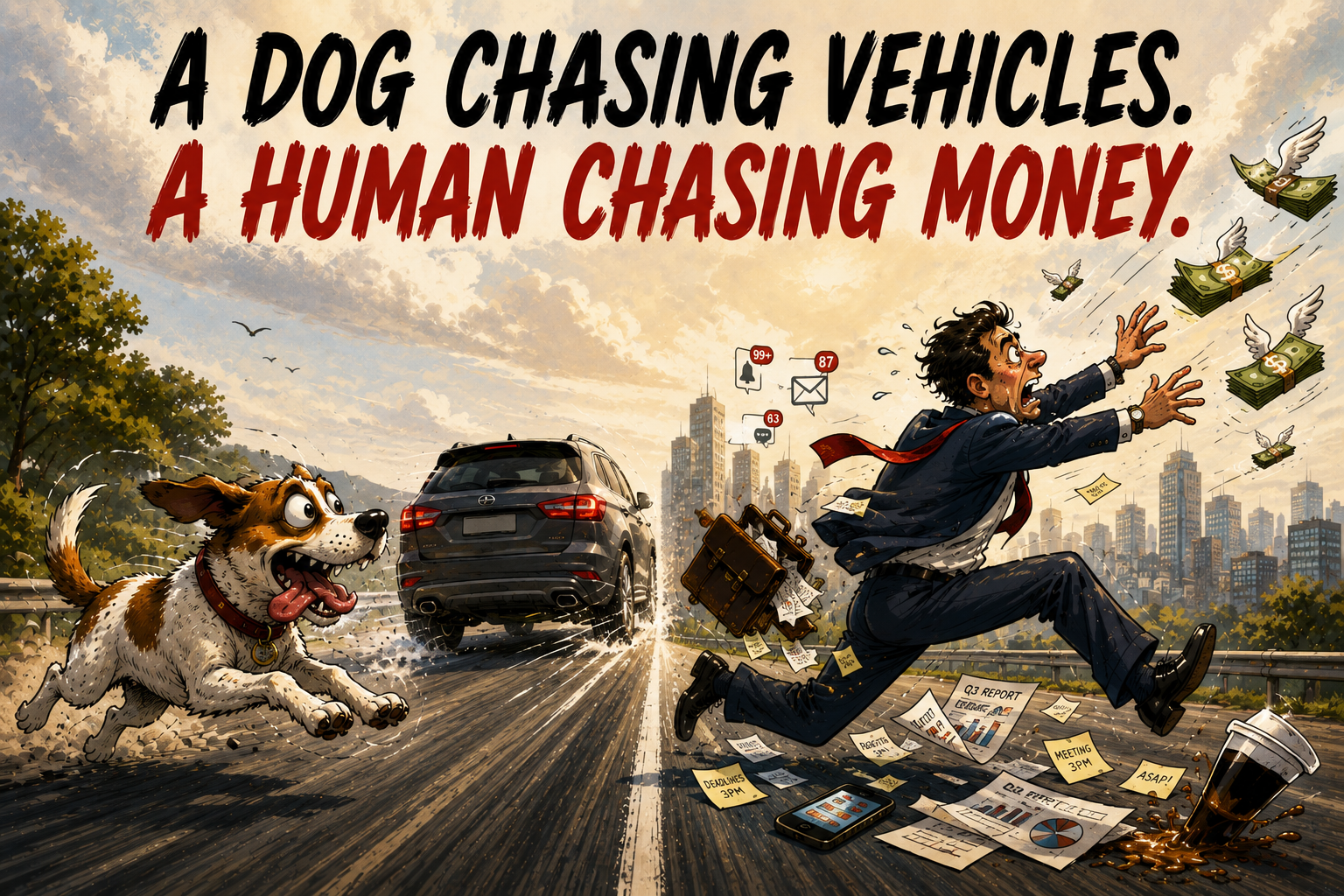
The attention economy — Right now, as you read this, engineers are being paid to make social media and short videos more addictive. Not more useful. More addictive. Alcohol took generations to understand and decades to regulate. The smartphone is cheaper, more powerful, always in your hand, running at 3am. People no longer sit with their food, their family, their own thoughts. The most basic human acts are being replaced by a scroll. This is not an accident. It is a business model. And what it is quietly building — across billions of people, including children — is a generation that cannot be alone, cannot focus, cannot feel the texture of an ordinary moment. Whole lives hollowed out. Just for engagement metrics!
This is not a list of accidents. This is a pattern. And patterns have architects.
The Green Revolution: Profit Dressed as Progress
One of the most celebrated stories of the 20th century deserves a harder look.
The Green Revolution is said to have saved the world from famine. That story deserves scrutiny.
India, for instance, did not suffer widespread famine when it grew millets. Millets need a fraction of the water that wheat and rice require. They grow in drought. They resist pests without chemicals. They provide more nutrition and keep you full longer. They fed populations for thousands of years — without debt, without poisoned water, without farmer suicides. The famines that devastated India were not caused by weak indigenous farming. They were caused by colonial extraction and deliberate policy. The Green Revolution did not save India from its own food traditions. It replaced them.
What replaced them was built around one number: yield per acre. Not soil health. Not nutrition. Not the wellbeing of the farmer. Just yield.
Calories went up. Nourishment went down. The diseases that were once rare — diabetes, obesity, nutrient deficiencies — rose sharply in the very regions that adopted these crops most aggressively. Water tables fell. Soils gave out. Farmers who could not afford the inputs went into debt. For many, the debt became a death sentence.
And who profited from all of this? The chemical companies who sold the fertilisers that millets never needed. The pesticide manufacturers whose products millets naturally resist. They created the dependency, supplied it at a price, poisoned the soil, the water, the farmer, and the consumer — and called it a revolution. Called it feeding the world. Called it charity.
Millets needed none of it. They were already the answer. They were displaced precisely because they required no inputs to sell, no debt to create, no dependency to maintain. A crop that grows freely and feeds well is not a business model.
This is not incompetence. This is the cancer logic applied to agriculture — aggressive, self-serving growth that destroys the very system it feeds on, while announcing itself as the cure.
We called it a revolution. We were describing the speed of the damage.
The Body Knows
The human body is one of the most extraordinary things in the universe.
It has roughly 37 trillion cells. Each one plays its part — breathing, digesting, repairing, defending. No cell works only for itself. Each one gives to the whole and receives from the whole in return. There is no boss cell. No cell that exploits another. The whole system works because every part serves the larger life it belongs to.
When a cell breaks that agreement — when it begins growing only for itself, taking without giving, multiplying without limit — we call it cancer. It does not announce itself as the enemy. It simply stops caring about the body it lives in. And it destroys what it depends on.
Our bodies are not the exception. They are the instruction.
A society that exploits its own people — by caste, class, gender, or race — is not just unfair. It is diseased. It weakens from the inside. And a weakened society, like a weakened body, becomes vulnerable to collapse and to being consumed by something stronger.
This is not philosophy. This is biology applied honestly to how we live together.
Every business, institution, and government that extracts from its own people rather than serving them is behaving like a cancer cell. The short-term growth looks impressive. The long-term result is always the same.
The Algorithm Was Written Wrong — And Not By Accident
Every system runs on rules that decide what counts and what doesn’t. Our global economy runs on GDP, stock price, quarterly earnings, and growth. These are the numbers governments celebrate, that markets worship, that careers are built around.
But look at what this algorithm actually measures.
A river clean and full of life — counts for nothing. Drain it, bottle it, sell it — now it counts. A forest standing for centuries — invisible to the economy. Cut it down and sell the timber — now it counts. A mother raising her children with full presence and care — zero. A child addicted to a screen, buying things to fill the emptiness — that counts. A farmer growing food in harmony with his soil — barely registers. A farmer deep in debt, buying chemicals, slowly ruining his land — the chemical company’s revenue counts.
A car crash counts. The hospital bills, the repairs, the insurance, the legal fees — all of it is growth. A community so healthy and trusting that nobody needs to sue anybody — worth nothing to this algorithm.
It is not blind by accident. It was written by people who owned capital, to measure and reward capital. Labour was a cost to minimise. Nature was a resource to extract. Community, care, trust, health, attention, love — none of these could be owned, so none of them were counted.
And because the algorithm cannot see what matters most, the system optimises ferociously for what it can see — transaction, extraction, volume, dependency — while systematically destroying what it cannot: soil, health, attention, connection, meaning.
The body runs a different algorithm. Every cell gives and receives. The health of each is measured by the health of the whole. There is no GDP cell that grows at the expense of the others and calls it progress.
We have the wrong code running. And the people who benefit most from that code are the least likely to rewrite it.
That is why the rewriting begins with us.
The Architecture of the Prison
Most of the harm in the world is not done by monsters.
It is done by ordinary people following instructions from which the human meaning has been removed. A manager hits a target. A scientist signs off on a funded study. A regulator follows the process. No one feels like a villain. The harm is spread so thinly across so many small decisions that nobody holds it.
This is the soldier mentality — and it is the engine behind every item on that list above. A soldier follows orders without question, without evaluation, without knowing or caring who falls. He does not ask whether the target deserves it. He simply executes. The scientist developing the pesticide he knows causes harm: soldier following orders. The engineer building the addictive feed: soldier. The banker structuring the predatory loan: soldier. Different jobs, same surrender: I was doing my job. Someone above me decided.
It requires no malice. Just the daily choice not to think for yourself.
But how did that choice become so easy? How was inner freedom lost?
Not through weakness. It was traded for a salary. For the ability to feed a family and pay rent. Someone controlled the land, owned the resource, held the money — and offered a small portion back in exchange for obedience. A trickle. Enough to survive on. Not enough to be free of the need for it. And with that came the unspoken agreement: don’t ask too many questions. Don’t let your conscience get in the way of the job. The soldier doesn’t choose the war. He just needs to eat.
Then the soldier spends his trickle — on rent, first of all. Paid to a landlord who did not create the land, who did not lay the roads outside, who did not build the water lines, the electricity grid, or the schools that make the location worth living in. All of that came from society — from collective taxes, collective labour, collective generations of building. Yet somehow the land and everything its value rests upon belongs to whoever had the capital to claim it first, and everyone else pays them monthly for access to what they never made. The soldier who contributed to building this world pays rent to live in it, to a person whose primary achievement was the ability to buy it first.
Then food bought from the same corporations he works within. Loans from the banks that fund the enterprise. Evenings lost to the platforms built to keep him distracted. The money was never truly his. It was lent briefly in exchange for his labour and silence, and returned almost immediately through everything he buys just to get through the week.
He pays to live in a world built by his own hands. He funds the power that keeps him from being free. He votes with every purchase for the system he privately resents.
But the money chain is only the outer wall. The deeper prison is built inside the mind.
Education shaped to produce workers, not thinkers. Media that makes the powerful look reasonable and the questioner look naïve. Religion misused to teach patience with injustice — suffering as God’s will, hierarchy as sacred order, silence as virtue. And now the attention economy finishes what the others began: by the time the scroll is done with you, there is no quiet left in which an honest thought could form. Distraction is not a side effect. It is one of the system’s most important tools.
The salary keeps the body working. The mindwashing keeps the soul from noticing.
Systems that reward those without empathy will keep elevating those most willing to cause harm. This is not a conspiracy — it is simple selection. A society that lets people who cannot love run its food, its medicine, its politics, and its money should not be surprised when those systems produce loveless results.
There is a philosophy that makes all of this easy to live with. You have heard it said: everything is fair in love and war. It is the psychopath’s favourite line — because it pre-justifies every harm and requires no further examination. If everything is fair, nothing needs to be answered for. Ruthlessness becomes realism. Exploitation becomes strategy. The suffering of others becomes collateral, acceptable, inevitable.
No. It is not fair. It has never been fair. And the ease with which someone says those words is itself a diagnostic — it tells you precisely how much of their conscience has already been surrendered.
Love has rules. War has rules. Life has rules. Not because rules are imposed from outside, but because we are cells in a living system — and a cell that ignores the rules of the body it belongs to has a name we have already used.
Removing such people from positions of power is not radical. It is common sense.
Dharma: You Cannot Leave the Moral Universe
Ancient Indian philosophy gave us dharma — doing what is right, living in alignment with a deeper moral order. It was never only for temples and saints. Merchants had dharma. Kings had dharma. As Kautilya wrote in the Arthashastra: commerce that harms the public good is not commerce. It is theft with paperwork.
Every lasting wisdom tradition has arrived at the same truth: you cannot separate how you make your living from how you live. There is no clean divide between the office and the soul.
And dharma cannot be handed to you by someone else. No employer, no government, no guru can see for you. A true guru does not command — he helps you see more clearly with your own eyes, then steps back. The moment a teacher demands obedience instead of honest questioning, he has stopped being a teacher and become a general.
Awareness. Inner freedom. The ability to choose consciously. Not the freedom to do anything — but the freedom of someone who looks clearly at what they are doing and takes full responsibility for it. A person whose conscience cannot be hired out.
We do not need the soldier in us — the obedient, the unquestioning, the one who acts because he was told to. We need the sage in us. The aware one. The free one. The one who looks clearly, chooses consciously, and answers to something deeper than a paycheck or a command.
That one has always been there. It is simply waiting to be chosen.
Love Is Non-Negotiable
Charaka, the great teacher of Ayurvedic medicine, left us something that has never stopped being true:
“A physician without compassion is more dangerous than the disease itself.”
This applies to everyone.
- A politician without empathy is a tyrant in a suit.
- A CEO without conscience is a legal looter.
- A scientist without ethics is a danger to the world.
- A food company without love for the child eating its product is more dangerous than hunger itself.
And it does not stop at the top. Every role carries this responsibility. The worker who cuts corners. The cook who ignores hygiene. The clerk who treats a struggling person with cold indifference. Each one is a small version of the same failure. Like cells in a body — every part either serves the whole or it doesn’t.
Love is not a soft quality reserved for leaders. It is the minimum standard for being human in any role, at any level.
This gives us one simple, practical test — a single question that cuts through every advertisement, every mission statement, every claim of social responsibility:
Would you give this to your own child?
If the executive who approved the addictive formula would not feed it to his own daughter — that quiet, private no holds the entire truth of the matter.
If a brand engineers food for children to be addictive and nutritionally empty, that brand is not feeding your child. It is farming your child. The product is not the food. The product is the dependency.
Do not do business with those who do not love what they claim to serve.
Ask of every business, every institution, every leader: Is there love here? Not branding. Not a slogan. Real love — visible in what they refuse to sell, in what they choose when no one is watching.
If the answer is no, walk away. Withdrawing your money and trust from the loveless is the most honest thing a person can do.
Love is not the opposite of profit. It is the only foundation on which real profit can be built. Without it, what looks like progress is just extraction in good clothing. Without it, what looks like success is a countdown.
Love is profit. Love is progress. Love is the only achievement that does not eventually turn to dust.
Gratitude and the Welfare of All
Before a person earns their first rupee or dollar, they have already received more than they can ever repay.
The air, the water, the language they think in, the roads, the medicine, the food grown by hands that will never know their name — all of it was there before they made a single choice. Every human being is born into a vast inheritance from nature and from every generation before them.
The only honest response to that is gratitude.
A selfish person is not just morally wrong. They are factually mistaken — they have looked at a life built on the gifts of millions and concluded they built it alone.
A business built on gratitude asks: What do I owe? A business built on selfishness asks only: What can I take?
One sustains the world. The other consumes it.
An economy built for only some will eventually fail everyone — just as a body cannot survive when one organ takes everything and the rest go without. The welfare of all is not a generous ideal. It is the only model that lasts.
What We Are Choosing
Dinosaurs could not negotiate with the meteor. We can negotiate with ourselves.
We are not short of intelligence. We are not short of resources.
We are short of honest intention.
The change does not start with a new law or a movement. It starts with a question, asked sincerely, by enough people, in enough places:
Not “What makes money?” But “What is right?”
History gives us every reason to believe this is possible — not as a wish, but as a fact.
There was a time when monarchy was considered the permanent, natural order of the world. The idea that ordinary people could govern themselves was seen as dangerous and absurd by everyone in power. And then it changed. Slavery was the foundation of entire economies. Then it ended. The silencing of women was written into law everywhere on earth. Then it changed. Empires that seemed unshakeable fell within a generation once enough people simply refused to accept them.
None of this was guaranteed. Each change was made — imperfectly, painfully, at great cost — by ordinary people who decided that the way things were was not the way things had to be.
We are at one of those moments again.
This time the opponent is not a king. It is a set of habits and assumptions that tells us greed is natural, that indifference is professional, that love is naive. It is a quieter tyranny than the ones before. But not a stronger one.
We are not a business. We are not a quarterly report. We are not a statistic, a demographic, or a line on anyone’s balance sheet.
We are human — the same species that ended slavery, built democracies, and dismantled empires that everyone said were permanent.
This too shall change. Because we will change it.
“Humanity and business are not two different languages. They must be the same sentence. We are humans first — and any business we conduct must be an extension of our morality, not a vacation from it.”
roodifood.com



Leave A Comment